
Inside Cellular Jail
What you will see, and how the building enforced isolation
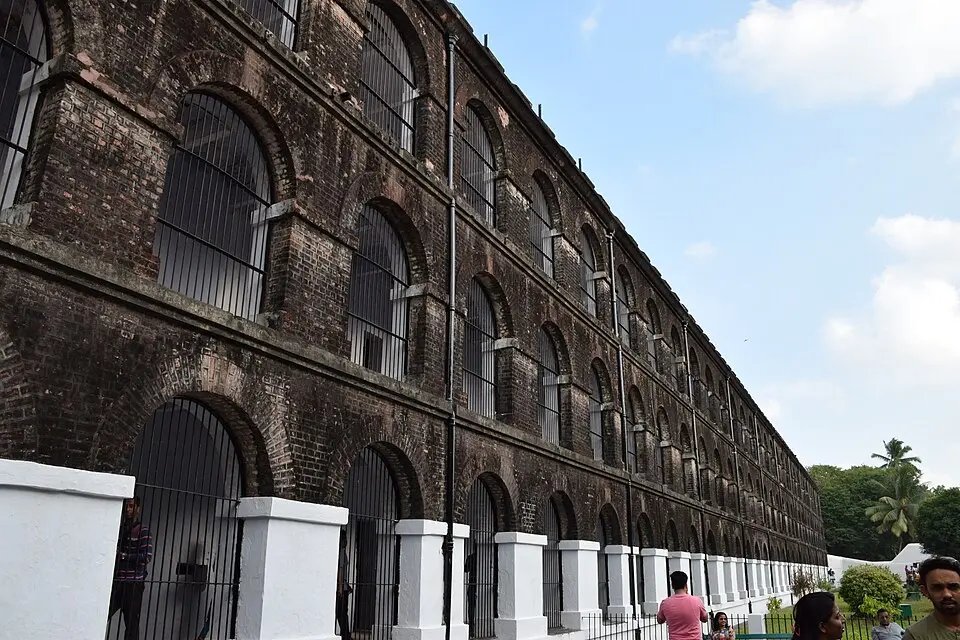
Among the people transported here was Babu Ram Hari, editor of Swarajya, who received a 21-year sentence after the colonial government judged three editorials to be seditious.[4] His record is one way to understand the building: Cellular Jail was designed not only to hold a person, but to prevent that person from speaking to another prisoner.
- Survives today
- Three of seven wings and the central tower.[1]
- Time to set aside
- About two hours if you want to read the galleries without hurrying.[6]
- Moving through
- The preserved prison is three storeys. Official visitor pages do not publish detailed step-free access information; confirm current arrangements before travelling.
- Two tickets
- Daytime museum entry and the evening Light and Sound Show are separate. See current timings and fees.
Enter the Corridor
The National Memorial contains the central watchtower, three surviving prison wings, rows of solitary cells and galleries about prisoners and India’s freedom struggle. Andaman Tourism also lists an execution room, prison-related objects and an audio-visual room among the museum’s features.[3]
Look at the architecture before treating the building as a list of exhibits. The long sightlines, repeated cell doors and tower were parts of one system: separation, observation and hard discipline.
Why Every Cell Faced a Wall
The original jail had seven unequal, three-storey wings radiating from a central watchtower. India’s UNESCO submission compares the arrangement to the spokes of a wheel. The front of one row of cells faced the back of another wing, restricting communication both within a wing and across the complex.[1][5]
The watchtower was the controlling centre. A guard could look along the radiating corridors, while a prisoner inside a cell could not know whether the corridor was being watched. The design combined the Separate System of individual confinement with an idea of surveillance influenced by the Panopticon.[1]
Inside a Solitary Cell
India’s UNESCO submission records cells measuring approximately 13.5 feet by 7 feet, arranged in a single row beside a four-foot-wide verandah. A heavy iron grille door was secured by a latch positioned outside the prisoner’s reach, and the cells had no toilet facilities.[1]
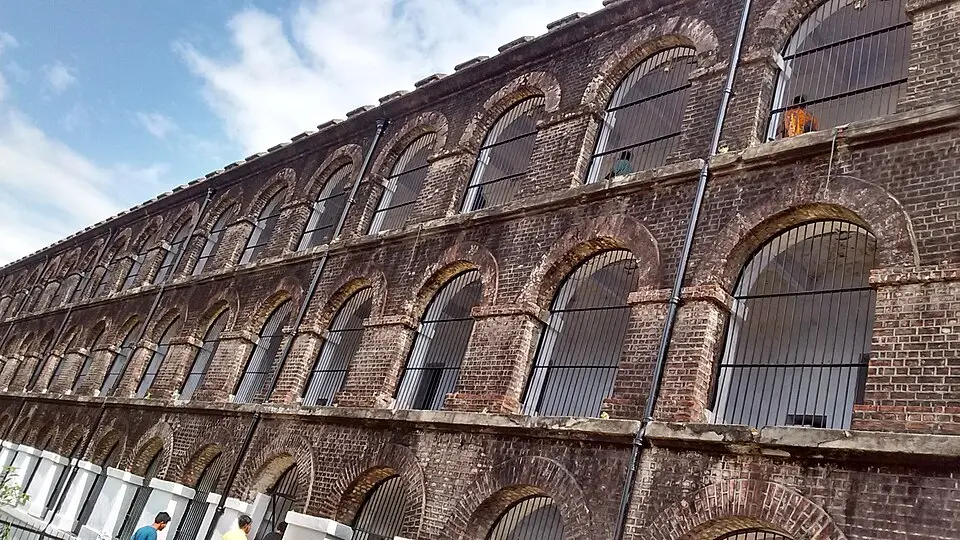
Institutional records disagree on the total number of cells. India’s UNESCO submission records 698. Ministry of Culture records describe 663 cells by 1905–06 and 30 more added in 1909, while PMML research records 689.[1][2][7] Because the sources count the complex differently, this guide does not present one disputed total as certain.
Forced Labour and Punishment
Official accounts describe prisoners being made to press oil, dehusk coconuts, pound coir, make rope, cut hills, fill swamps, clear forest and lay roads. Prisoners unused to this work could fail the daily quota and face further punishment.[4]
Another Ministry of Tourism account lists extra hours at the grinding mill, restraints, solitary confinement and starvation diet among punishments used in the system.[5] These records are why the visit should be understood through the people confined here, not only through the surviving masonry.
What Survives, and What Was Lost
Official accounts agree that three wings and the central tower survive, but they do not describe the loss of the other four wings in exactly the same way. India’s UNESCO submission connects their demolition with damage from the 1941 earthquake and later events. The Ministry of Culture says two wings were dismantled during the Japanese occupation for building material and two later made way for Govind Ballabh Pant Hospital.[1][2]
The Ministry of Culture identifies Wings 1, 6 and 7 as the preserved wings. The diagram does not assign those numbers to compass positions because the reviewed sources do not provide a dependable visitor-ready orientation plan.
Cellular Jail is on India’s UNESCO World Heritage Tentative List, but it is not a World Heritage Site. Read the current UNESCO status.
What the Museum Contains
Andaman Tourism lists a Freedom Fighters’ Gallery with photographs, belongings and records, prison cells illustrating solitary confinement, punishment-related objects and replicas, paintings and sculptures, and an audio-visual room.[3]
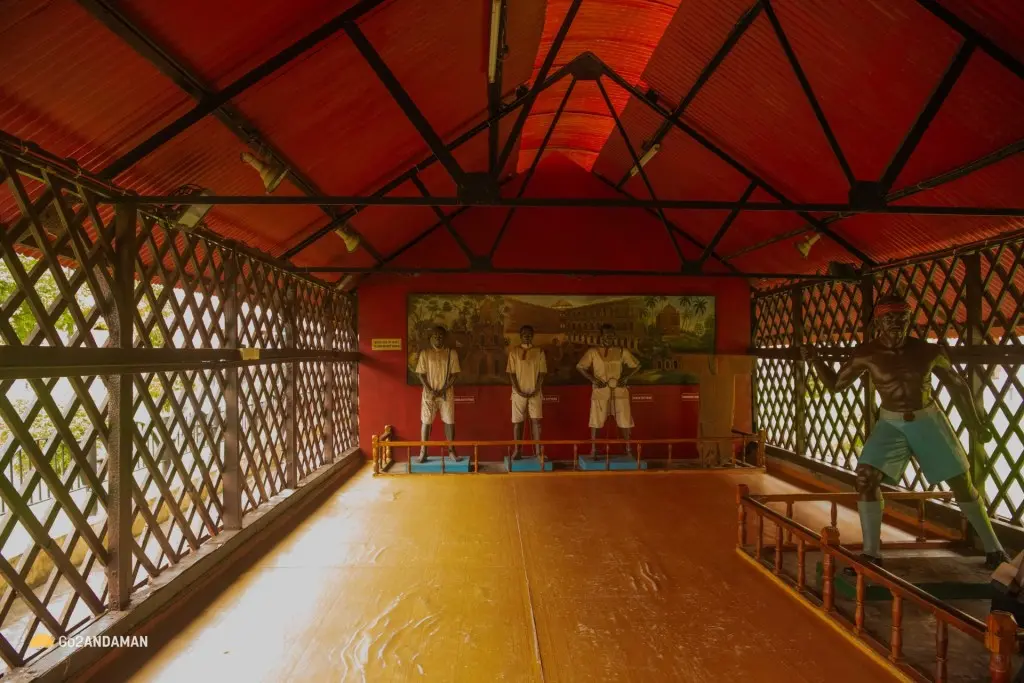
Treat the official list as an overview, not a guarantee that every room or display will be open during a particular visit.
Visit Respectfully
Allow time to read names and records, keep voices low in the cell corridors, follow museum photography rules and avoid using the prison merely as a dramatic photo backdrop.
The daytime museum is currently open Tuesday to Sunday in two sessions, with a midday closure. It is closed on Mondays and national holidays. The evening show uses a separate ticket and currently includes Monday performances.
Check the latest museum hours and entry fees, then use the Light and Sound Show guide for current languages, prices and the official booking link.
CellularJail.com is not the official website of Cellular Jail or the Andaman and Nicobar Administration. The diagram is an explanatory original based on the cited records, not an official floor plan.
Sources
- India’s 2014 UNESCO Tentative List submission
- Ministry of Culture: The Making of the Cellular Jail
- Andaman Tourism: Cellular Jail Museum
- Press Information Bureau: Cellular Jail – An Embodiment of Sacrifice
- Ministry of Tourism: Cellular Jail – Letters, Memoirs & Memories
- Incredible India: Explore the Fascinating Colonial Heritage of Andamans
- Prime Ministers Museum and Library: Colonial and post-colonial discourse on Cellular Jail