
Kala Pani Jail: Meaning and History
The Andaman penal settlement, transportation and Cellular Jail
Historical claims checked on 14 September 2026 against the institutional and scholarly sources listed below. Visitor information was checked against Andaman Tourism on the same date.
What Does Kala Pani Mean?
Kala Pani translates as Black Waters. India’s 2014 UNESCO Tentative List submission says the remoteness and terror of the Andaman prison gave it this name.[1]
The phrase did not originally describe only one building. Historian Clare Anderson’s research treats kala pani as the wider colonial system of transportation, exclusion and isolation in the Andamans. Cellular Jail was later built as a stricter place of solitary confinement within that penal settlement.[2]
Is Kala Pani the Same as Cellular Jail?
Not exactly. The British re-established the Andaman penal settlement after the uprising of 1857. The first batch of 200 convicts arrived on 10 March 1858. Cellular Jail came later: India’s UNESCO submission records a construction order in 1893 and completion in 1905–06.[1]
Today, people commonly use “Kala Pani Jail” for Cellular Jail because the surviving National Memorial is the most visible symbol of the Andaman punishment. Historically, however, Kala Pani also covered transportation and prison life elsewhere in the penal settlement before Cellular Jail existed.
Why Was Transportation Feared?
Transportation removed prisoners from the mainland and placed them in an island settlement under colonial control. The punishment involved separation from family and society and a long sea crossing. Scholarship also shows that the colonial idea of Kala Pani and the way individual convicts experienced transportation were not always identical, so this guide does not reduce every prisoner’s experience to one explanation.[2]
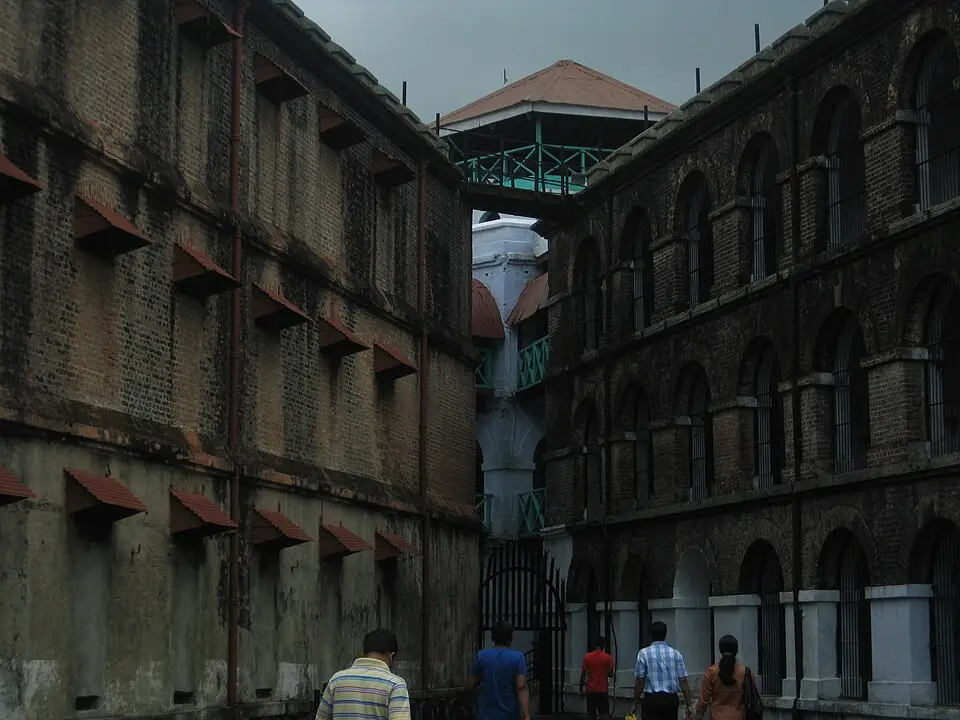
Inside Cellular Jail, architecture added another level of isolation. Seven three-storey wings radiated from a central watchtower. Individual cells followed the Separate System, limiting communication between prisoners. Prison labour was used to construct the jail.[1]
Labour, Isolation and Punishment
Institutional records describe solitary confinement, restraints, flogging and severe work quotas. Labour included oil grinding, coir pounding and rope making. The Andaman administration’s prison-life archive reproduces accounts by former prisoners describing daily rations, oil mills, coconut work and punishment when quotas were not met.[1][3]
These records must be read as evidence of individual experiences, not as proof that every prisoner had exactly the same sentence or treatment. For the longer chronology, documented hunger strikes and named political prisoners, read the history of Cellular Jail.
What Can Visitors See Today?
Three of the original seven wings and the central tower survive. Cellular Jail is now a National Memorial and museum. Andaman Tourism lists galleries, prison cells, punishment-related objects and replicas, paintings, sculptures and an audio-visual room among the museum displays.[4]
Use the visual guide to the surviving cells, wings and tower to understand the layout before visiting.
1:30 PM to 5:00 PM
₹100 for foreign nationals
Check the current museum timings and entry fees. The evening programme uses a separate ticket; see the Light and Sound Show schedule and official booking link.
Common Questions
Where is Kala Pani Jail?
Cellular Jail National Memorial is at Atlanta Point in Sri Vijaya Puram, the city long known as Port Blair, in the Andaman and Nicobar Islands. Open the location linked by Andaman Tourism in Google Maps.
Is Kala Pani Jail closed?
The memorial is open to visitors, but the daytime museum is currently closed on Mondays and national holidays. The separate Light and Sound Show has performances on Mondays. Check the official portal before visiting because schedules can change.[4]
Who built Cellular Jail?
The British colonial administration ordered the prison. India’s UNESCO submission states that transported prisoners carried out the construction work and that building material was brought from Burma.[1]
CellularJail.com is not the official website of Cellular Jail or the Andaman and Nicobar Administration. Current tickets and government notices are available through Andaman Tourism.